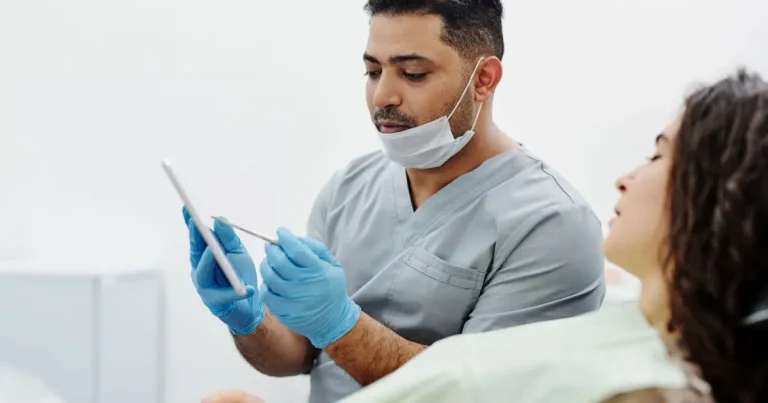

Three facts shape every dental assistant career in the U.S.:
- Many states let dentists train assistants on the job for basic duties, so a formal program is not always required to start.
- Taking X-rays is the big exception. Most states regulate dental radiography and require a course, an exam or a state registration before an assistant exposes radiographs.
- The Dental Assisting National Board (DANB) runs the national exams most states use, so its exams show up again and again in state rules.
The rest of this guide is about putting those three facts together for the state where you plan to work.
On-the-job training or a program?
The U.S. Bureau of Labor Statistics notes in its Occupational Outlook Handbook that some states require graduation from an accredited program and an exam, while others have no formal education requirement and allow on-the-job training. Programs are mostly offered by community colleges and some technical schools; one-year programs lead to a certificate or diploma, and two-year programs to an associate degree.
On-the-job training works best in states that allow it and when a practice is willing to teach. You earn from the first day and learn that office’s way of doing things. The downside is that your training may be narrow, and you may still need a separate radiography course before you can take X-rays.
A formal program costs money and time, but it typically covers chairside assisting, infection control, dental materials, radiography and office procedures, with lab work and a clinical externship. Programs accredited by the Commission on Dental Accreditation can also open certain DANB eligibility routes and satisfy states that require accredited training for expanded duties.
X-ray rules: two state examples
Texas
The Texas State Board of Dental Examiners says a dental assistant may not position or expose dental X-rays without a dental assistant radiology registration issued by the board. DANB’s summary of Texas rules adds that an assistant in on-the-job training may perform radiological procedures for up to one year, under the direct supervision of the employer dentist. Texas does not recognize registered dental assistant certificates issued by other states, so people moving in need to register in Texas.
Maryland
Maryland is stricter on the training side. According to DANB’s state summary, candidates must complete an approved radiography course of at least 24 hours and pass DANB’s Radiation Health and Safety (RHS) exam or the CDA exam before applying to the state. On-the-job training alone does not qualify an assistant to operate X-ray equipment there.
Other states fall between these two. DANB keeps state-by-state requirement pages, which are a good starting point, but always confirm with your state dental board because rules change; Iowa, for example, rescinded part of its examination rule in 2025.
The DANB exams
RHS (Radiation Health and Safety). Covers exposing and evaluating radiographs, quality assurance and radiation safety. It is the exam most often named in state X-ray rules.
NELDA (National Entry Level Dental Assistant). Made up of three component exams: RHS, Infection Control (ICE) and Anatomy, Morphology and Physiology (AMP). The components can be taken separately or together, which suits new assistants building credentials over time.
CDA (Certified Dental Assistant). DANB’s flagship certification, with RHS and ICE as components plus a general chairside exam. It has eligibility routes based on accredited program graduation or work experience. Many employers treat the CDA as a sign of an experienced assistant.
A checklist before you start
- Find your state dental board’s rules for dental assistants and for radiography.
- Confirm whether on-the-job training is allowed for the duties you want to perform.
- Identify the exact course and exam needed for X-rays in your state.
- Decide between on-the-job training and a CODA-accredited or state-approved program.
- Check whether your state requires CPR certification, a jurisprudence exam or a background check for registration.
- Note renewal and continuing education rules once you are registered or certified.
What first jobs look like
Most new dental assistants start in general dentistry offices, setting up and breaking down operatories, sterilizing instruments, passing instruments chairside, taking X-rays (once qualified), recording notes and helping patients feel at ease. Some start at the front desk and move to the back office. Specialty practices such as orthodontics and oral surgery also hire entry-level assistants, sometimes with their own on-the-job training.
Your first months are mostly about speed and routine. Dentists notice assistants who anticipate the next instrument, keep the operatory stocked without being asked and follow infection control steps the same way every time. If your state requires a radiography credential and you do not have it yet, say so plainly in interviews and give a date by which you will finish the course and exam. Many offices are willing to hire someone who is close, but they need to know the timeline.
The BLS reported a median pay of $48,070 a year for dental assistants in May 2025 and projected 7 percent employment growth from 2025 to 2035. Pay depends heavily on state, setting and credentials, and growth figures describe the field, not your individual chances.
Before paying for any program, use our checklist on choosing a certificate program, and if you are weighing a hybrid course, read our comparison of online and in-person training, since radiography and chairside skills need lab time.
A simple next step
Open your state dental board’s website today and find two things: what a dental assistant can do without any credential, and what is required before taking X-rays. Write them down. Then call two dental offices near you and ask whether they hire and train entry-level assistants. Those two answers will tell you whether to start with a job, a radiography course or a full program.